Showing posts with label AutomobileDesign. Show all posts

Friday, May 03, 2013

Detroit automakers doing well....sort of

 
The other day in the USA TODAY, a headline in the Money Section caught my eye and made me smile.  It’s been a long time since I’ve seen a headline in the newspaper proclaiming, “Detroit leads March auto sales.” 

As a dyed-in-the-wool domestic automaker defender – some say apologist – it gives me enormous pleasure to read the monthly sales figures out of Detroit and see that the Domestic Three (GM, Ford and Chrysler Group) are slowly but surely gaining sales and even respect.

I am a realist, however.   The improving Domestic Three automakers will never be a dominant force and become known as the BIG Three again.   Presently the best market share that GM, Ford and Chrysler Group could muster in March was 16.9 percent, 16.2 percent and 11.8 percent of U.S. sales respectively.

Back during my college days in the early 1960s, the leading auto news story was rather the U.S. Justice Department’s antitrust division would pursue its goal of breaking up GM because of the giant company’s overwhelming, monopolistic 60 percent vehicle share in the early 60s.  Apparently the government felt that dividing GM into two companies – one made up of Chevrolet and the other selling Pontiac, Olds, Buick and Cadillac – would give competitors Ford and Chrysler Corporation a more level playing field.

Well, as we know, the playing field got leveled all right, and it wasn’t the outcome of an antitrust suit but rather unexpected competition from imports; first from Europe, then from Asia later in the century.

It’s seems almost unimaginable when reflecting on it today that GM once briefly held over 60 percent of the U.S. market, followed by Ford’s typical 25 – 30 percent share and Chrysler’s 10 – 15 percent take.  I recall as a young man how easy it was to remember the size of each American automaker’s market share.  Take GM’s typical 50 percent figure, divide it by 2 to get Ford’s figure and divide again by 2 for Chrysler’s.

My, how times have changed.   Back in the day when the Big Three dominated, the U.S. auto-making triplets garnered almost 100 percent of the market.   Now, as sales figure from last month show, their total U.S. share amounts to a measly 44.7 percent.  My 50-25-12 sales formula of old doesn’t work any more – by a long shot.

Also showing just how different things are, Chrysler is now only a few percentage points behind Ford in market share and the Blue Oval brand is only a tick or two behind perennial sales leader GM. 

Not only did Chrysler survive the severe recession and emerge as a partner with Italy's Fiat, the company managed to revive its dated automotive lineup with a slew of freshly restyled and very successful products. None represented their efforts better than the mid-size 200, a revamp of the unloved Sebring, which was successfully introduced by rapper Eminem at the 2011 Super Bowl. 


From the sales figures, one could assume that Detroit is in one heap of trouble.  But sales share don’t tell the whole story.   A better barometer of company’s health is how profitable it is.   I’m please to report that the Domestic Three are now lean and mean money machines and the future looks pretty good indeed.

Following the hurtful economic implosion of 2008 – with GM and Chrysler emerging from bankruptcy – all of the automakers used the business meltdown to close under-used factories, shed a large number of workers and eliminate hundreds of millions of legacy costs that had been weighing them down for decades.

While the domestic automakers are only a shadow of their formal selves, they are financially healthy and record or near profits are the norm again.  Gone are costly incentives and over-production.  Now the companies wisely sell only what they build.   Too, after working hard to catch up, the quality of U.S.-made vehicles is equal to or maybe even better than those built by the foreign automakers.

The aforementioned USA TODAY article pointed out that the “Detroit automakers ruled the March sales charts, parlaying their truck and SUV expertise into solid gains while Asian rivals – except for Honda – lagged.”  I swelled with pride when I read that lead off statement.

USA TODAY’s auto writer ended his column by noting the following auto trends and I paraphrase.
- The strong uptick in pickup sales will benefit the U.S. automakers because they still dominate the full-size pickup market.   With the improving housing market resulting in more houses being built, homebuilders will be replacing pickups and that spells good news for Detroit.  It has been reported that automakers can earn up to $10,000 to $15,000 net profit on each truck sold!
- SUVs are still popular and those expensive models are cash cows for the Domestic Three as well.  GM recently freshened its three middle priced SUVs, the Chevy Traverse, GMC Acadia and Buick Enclave.  All three experienced robust sales increases in March.  Happily, GM will be replacing its full-size and popular Suburban, Tahoe and Yukon models later in the 2014 model year.  Ford’s Explorer had its best March since the current model was introduced in 2010.  Chrysler’s Dodge Durango/Jeep Grand Cherokee were also recently freshened and are gaining many new buyers.
- While Toyota, Nissan, Hyundai and Kia all experience either flat sales or declines, Honda managed a 9.4 percent increase in sales in March, thanks to brisk sales of its all-new Accord and CR-X and the freshened Civic.

So it is a good time to be a Detroit Three adherent.  The domestic automakers have not only dodged another economic bullet, but have emerged in pretty fine shape to face another day.  I couldn’t be happier.


Sports car enthusiasts are grateful that GM's bankruptcy troubles in 2009 didn't postpone too long the introduction of the 7th generation Chevy Corvette Stingray.  A huge crowd pleaser at every auto show, the Bow Tie division appears to have hit a home run and will offer a true world beater in the competitive sports car market, starting later this summer.


Ford weathered the Great Recession and now offers a line-up of winners including the Focus, Fusion and Explorer.  Needing a lot of work is the Blue Oval's luxury brand, the Lincoln.   Arriving now at dealerships - be it belatedly - is the all-new MKZ luxury sedan (shown).  Next up is the smartly styled MKX crossover based on the popular Ford Escape, introduced as a concept at the January Detroit auto show.  


Tuesday, April 16, 2013

Seeking special Cadillacs

What's a Cadillac without a fin.
 
This time of year I really look forward to the daily visit from my mailman.  The deadline for vehicle entries for the upcoming Concours car show in August is approaching and I receive a number of applications each day.   I have a smile on my face when I open each envelope; eagerly anticipating what vehicle has been submitted.

When all the entries have been received by mid-April and made into a PowerPoint presentation, the volunteer Concours selection committee will meet and review all the submitted vehicles.  From the volume of mail so far, it appears we will have a record number of vehicle owners wishing to have their car, commercial vehicle, motorcycle or bicycle in the fundraising event.

This year the Concours selection committee will again descend on Hickory Corners in late April and assemble in a meeting room of the Gilmore Car Museum.  From the submitted entries the committee will select approximately 90 vehicles, including a representative sampling of Cadillacs, this year’s featured marque. 

As I write this column, 12 Cadillacs have been submitted.  That’s a good number but we are short of Cadillac entries for the 1915 – 1940 period and for the 1950s.  The decade of the sixties is well represented with a large number of entries submitted.

Naturally we want a selection of Cads that represent the luxury brand throughout its long history.  We are especially interested in showing some of the magnificent Classic Cadillac offerings from the twenties and thirties and also two other key examples; a 1948 model to show the beginning of the fin age – which Cadillac introduced that year – and the iconic 1959 model that took the fin age to its outrageous zenith.

There are two “special feature” classes in the Concours this year.   We are seeking a number of vehicles from the turn of the 20th century for the “High Wheeler” class and a few more for the “Lady Owned Cars” special class.

Fortunately, we already have a nice selection of entries for the “Lady Owned Cars” class.  Female interest in the collector car hobby is growing and this year the Concours leadership thought it was time we highlight this car-collecting phenomenon with a special group.

So far we have no entries for the “High Wheeler” class.   If none are received by April 20, committee members and I will get busy and contact the various high wheeler car clubs in the country and see if we can stir up some interest.

For those not familiar with a high wheeler vehicle, here’s a short history lesson.  The high wheeler is an early car body style that is unique only to the United States.  As the name implies, vehicles called high wheelers were built with slender, large-diameter wheels beginning in the late 19th century.  The last high wheeler was probably built around 1910.

Prior to the advent of gasoline engines, high wheelers were powered by electric motors or steam engines.  The high wheeler’s popularity began to wane when standard automobiles became both less expensive and more sophisticated.  It has been written that when Henry Ford introduced the Model T, the high wheeler era rapidly came to an end.

Automobiles with the slender high wheels often used solid tires.  The wide diameter of the wheels provided ample ground clearance.  This was a necessary feature because most roads in America at the time were primitive.  High wheelers also were designed with a wider track than those found on a standard automobile.

The high wheelers were available in many body styles (utility vehicles, runabouts/roadsters; some with detachable tonneaus) and often shared features found on horse-drawn wagon like wood-spoke wheels, similar suspensions and boxy bodies made of wood.

Over 40 high wheeler companies were in business at one point in the United States.  A few had names that might be recognizable – like the Cole, Duryea, Economy, International Harvester, and Sears – but most had a moment in the sun and then disappeared.

Attendees of the Concours car show may recall last year the 1909 Economy G Surrey high wheeler that was featured in the “Family Owned Vehicle” class.  Brady and Emily Mann of Roanoke, IL brought the Economy that his grandfather had purchased new over one hundred years ago.

Readers who know someone who owns a well-preserved high wheeler is urged to contact me.  We’ve had a few of high wheelers in our show in the past and the quaint and almost pre-historic looking automobiles are huge crowd pleasers.

The Concours featured designer this year is retired GM designer Bill Porter of Whitmore Lake, Michigan.  I interviewed Bill a while back and will share highlights of his exciting career with readers in an upcoming column.  

Bill headed both Pontiac and Buick design studios during his career.  Without a doubt his most notable effort while at Pontiac was overseeing the creation of the second gen 1970 Pontiac Firebird.  He takes extra special pride in developing the Firebird Trans Am of that period. 

Bill will join narrator Ed Lucas during the noon Pass in Review and discuss all the cars in the show that he had a hand in designing.   Take a look at the list below and contact me if you or if someone you know owns one of these Porter-influenced vehicles. 

The Porter-designed cars we’d like to have in this year’s Concours include:
1968 – 69 Pontiac Le Mans and GTO, 1970 – 72 Pontiac Catalina, Bonneville, 1970 ?  – 73 Firebird and Firebird T/A, 1973 Pontiac Le Mans, Grand Am, 1978 Pontiac Grand Prix, 1985 Buick Electra, 1982 Pontiac Firebird, 1991 Buick Regal 4-door sedan, 1986, 1992 and 2000 Buick LeSabre, 1991 and 1996 Buick Park Avenue and Ultra and 1995 Buick Riviera. 

Mr. Porter, now in his eighties, is a dynamic speaker and will give a pre-Concours presentation on Friday night, August 9.  Details on location and time of the program are incomplete.  Watch for announcements in this column in July.

Sunday, November 25, 2012

Capturing the art of the auto


-->
The tail fin defined the Cadillac during the fifties and none shouted Cadillac like the P-38 Lightning aircraft-inspired tailfins found on the 1948 – 1956 models.  A close-up shot of this 1955 Cadillac Eldorado iconic fin best personifies the luxury brand’s tail fin legacy.


I’ve been eyeballing automobiles since 1954.  Regardless of where I am – in a parking lot, on the freeway or on Niles Avenue – my eyes screen each car that passes by.   I can’t help it.

In the 58 years since my automotive awakening I’ve acquired a fondness for a number of the older cars once spotted on the highways.  Of late I have made an effort, when attending car shows, to capture images of these favorites with my camera at car shows.

With some cars, I like only a portion of the overall design, like the grille or the rear taillight.  So over the past many years, I’ve been drawn to photograph only a section of the vehicle in an artistic fashion.   Some have actually come out pretty nicely and can almost be consider works of art – at least to my eyes. 

I was pleasantly surprised recently when someone visited the Concours d’Elegance of Southwest Michigan’s Facebook page and wrote a complimentary remark about a photo I had posted of a 1955 Cadillac Eldorado rear quarter fender view.  I had used this particular photo when I announced the recent decision by the Concours National Advisory and Executive Boards that the Cadillac would be the featured marque in 2013 to commemorate the luxury automaker’s 110th anniversary.

The Facebook visitor’s comment, “This picture in undeniably beautiful” made my day and got me to thinking about some of the other photos of cars that I’ve taken over the past 10 – 15 years. 

So I opened my iPhoto album – now filled with 5,452 images – and looked for my favorite pictorial “car parts,” so-to-speak.   I found a number that really ring my bell.

The aforementioned 1955 Cadillac photo is at the top of the list.   If you want a photograph of GM’s luxury division that say loud and clear “I’m a Cadillac,” then I feel this photo accomplishes the task.   I only shot the tail of the car and from slightly above.  The famous P-38 Lightning aircraft-inspired tail fins were used on the Cadillac from the 1948 original until through 1957 model.

This picture resonates even though the trunk on the vehicle in the photograph isn’t completely closed.  The strong sculptural statement of the finned taillight simply carries the day.

Another photo that garners comments when I share it is one I took many years ago while visiting Carlisle, (Pa.) Chrysler Nationals.  I’m a huge fan of Virgil Exner, Sr.’s 1955 cars that featured the “Forward Look.”  But what makes my photo of this particular Dodge notable isn’t the car’s handsome grille, but rather the dramatic effect caused by reflection in the chrome trim from the overhead stripped canvas tent.  It reminds viewers of peppermint candy and makes the photo memorable.

I often discover that shiny car surfaces make great mirrors for self-portrait.   In 2009 at Hershey, Pa., I came across a really nice black 1954 Buick Special. 

In 1954 GM introduced all-new Olds, Cadillac and Buick models.  I liked the cars a lot because they all featured the first mass-produced wraparound windshields.  Of the three GM luxury cars, I have always favored the Buick and its rear subtle fin.  When I spotted the black 1954 Special at Hershey, I had to take a photo of that fin.  The self-portrait was just a bonus.

I’m not savvy enough to use PhotoShop.   I take a photo and if it turns out great, it’s pure luck.   I attended the since-discontinued Venetian Festival car show some years back and took a photo of a nice two-tone 1955 Chevy Bel Air.  

This image isn’t quite a work of art but it captures perfectly the essence of the new, clean styling of the popular Chevy.  Most folks seem to like the 1957 Tri-Five Chevy better than the initial ‘ 55, but I’ve always been won over by the clean, pure lines of the original.  

Few cars are introduced that are perfect in every way.  With the ’55 Chevy I wouldn’t change a thing.  The 1955 Chevy is one of those perfect cars, in my opinion, and this photo shows why.  This cleanly designed, unadorned beauty represents the very best from GM’s top designer Harley Earl.

I admire all classic Packards and can understand why the luxury brand remains a favorite of serious collectors.  At Hershey this past fall I spotted a beautiful roadster from afar.   I wasn’t drawn to it because it was a Packard, but because of its beautiful color.  It shouted, “Look at me!” 

On closer inspection, I became enamored by the beautiful wheels on the 1929 automobile.   Disc-like, they were painted the same color as the car’s body.   Most importantly, in the wheel’s center, was the traditional Packard red hexagon.  This photo captures flawlessly the combination of colors and shapes that work beautifully together and pleases the eye.

Great art?  No, but it reveals perfectly the elegance of the era.

If you would like to see my photos that I’ve mentioned in today’s column in high definition, please visit my blog site at http://darscars.blogspot.com/.  I will post all the photos that I’ve mentioned.  I also welcome your comments on my blog. 

By the way, if readers use Facebook and have not yet visited the Concours d’Elegance of Southwest Michigan Facebook page (www.facebook.com/ConcoursSWMI), please do so.   And while on your visit, please “like” us.   It will keep you connected with the many activities of the fundraising event.


 Take a shiny, curved chromed surface and add color stripes from an overhead tent and you have a dramatic photograph.  This 1955 Dodge Royal Lancer was snapped by Dar at a Carlisle, Penn. Chrysler National show a few years back.


Whether up close or from afar, an automobile painted a gorgeous color will capture attention.   And none did it better than this 1929 Packard at Hershey.  Dar snapped the automobile’s wheel, capturing both the elegance of the wheel design and the stunning turquoise and red color combination.


 A 1954 black Buick Special rear fender makes for a perfect mirror to caption a self-portrait.  This photo may not be great art, but it speaks to the writer because the ’54 Buick is a favorite of his.


Both Dar’s grandfather and brother owned a 1955 Chevy.  The all-new car was one of Chevrolet’s most significant models, as it introduced not only its famous small block V-8 but also fresh, clean new styling, as shown in this rear quarter view that still looks fabulous 57 years later.


Sunday, November 18, 2012

Dowagiac duo's dynamic car


With a thorough restoration completed the day before the Concours car show, this beautiful 1932 Auburn Speedster Boat Tail roadster won the hearts of both judges and visitors by winning both the Big Boy Restaurant Best of Show trophy and the Corvette Central People's Choice trophy.  Fewer than 75 Speedsters were built in 1932 and owners Don and Joan Lyons of Dowagiac bought their automobile from an owner in Grand Rapids.  Photo provided by Mark Parren

At last summer’s Concours car show, one automobile truly stood out.  It was such a standout that it garnered both the affections of the public and winning the People’s Choice trophy as well as the heart of the judges in receiving the Best in Show trophy.  Rarely does the same vehicle earn that dual accomplishment.  I’m speaking, of course, about Don and Joan Lyons’ 1932 orange and black Auburn boat tail Speedster.

Before I share Don and Joan’s story on how they acquired and restored the rare Auburn, I’ll share a little history about the Auburn.  The Auburn Automobile Company was founded in Auburn, Indiana as the Eckhart Carriage Company in 1875.  Experimenting with automobiles early on, by 1909 the company had absorbed two other failed automakers and had moved into a larger plant.  The plant, after limited success, was closed during World War I due to a materials shortage.

Following the war the Eckharts sold out to a Chicago investment group who revived the business but met with little financial success.  In 1924 the group sold the automaker to Errett Lobban Cord, a highly successful auto salesman who then went on to aggressively market the company’s unsold inventory.

In 1926 E. L. Cord expanded the Auburn Company by partnering with the Duesenberg Corporation, an automaker famous for its racing cars.  The year 1929 also saw the introduction of a third model, a front-wheel drive car that E. L. put his own name on, the Cord L-29. 

Unfortunately, the Auburn-Cord-Duesenberg Company offered fabulous but expensive vehicles in a depressed market severely beaten by the Great Depression.  Sales plunged and the A-C-D Company went bust by 1937 but not before a number of outstanding vehicles were designed and built.   Those include just about any model of the mighty Duesenberg, the stunningly beautiful, Gordon Buehrig-designed 1936-37 Cord 810/812 and any number of fabulous Auburns including the Lyons’ beautiful 1932 Auburn Speedster that was designed by Alan Leamy.

The automobile that garnered nearly all of the votes in the People’s Choice balloting at the Concours was a product of the E. L. Cord years.  The Auburn Speedster (we only later stuck the Boat Tail label on the car) was a car frequently seen in wealthy communities like Hollywood and Palm Springs.

What attracted wealthy buyers to the Auburn was both stunning looking vehicles and powerful performance.  The 1932 Auburn Speedster provided a fast ride by offering a 268 cu. in./4.4-L straight eight that boasted 100 bhp.

A few years back I wrote a column about Don Lyons and his extensive automobile collection.  He has owned a number of fabulous vintage cars and, like his father before him, did a lot of the restoration and mechanical work himself.  

Folks in Dowagiac know Don as Mayor Lyons, a position he has held for the past 15 years.  Though now retired, he continues to serve as chairman of the board of Lyons Industries, Inc., a manufacturer of plumbing fixtures located west of Dowagiac on the city’s edge.  He also remains active with the Heddon Museum in Dowagiac, which chronicles the many contributions of the Heddon family to the Dowagiac area, especially their fishing tackle company.  Readers wanting more information about the museum may either visit www.heddonmuseum.org or call 269 782-5698.

One of my first questions to Don when I interviewed him for this column was how he managed to acquire his rare Speedster.   He didn’t attend the Scottsdale, Arizona auctions; rather he found the car in Grand Rapids.  He had known of the car for a number of years and in 2009 he convinced the owner to sell.

According to Don, there were three series of Auburn Speedsters:  those built in 1928-29, those produced in 1931-33 and the last batch in 1935-36.  There were no Speedsters built in 1930 or 1934. I was amazed to hear that in total only about 75 1932 Speedsters built. Don’s favorite is the 1932 model and that’s the one he and Joan bought.

Once the purchase was made, the Speedster’s next trip was a visit to Bill Godisak’s Sun Ray Restoration in Dowagiac for a complete restoration right down to restoring each facet on every nut and bolt in order to preserve the original old style fasteners.  Ultra-Tech Racing Engines in Mishawaka, Indiana rebuilt the car’s motor.    The Ultra-Tech team put in new bearings, bored out the cylinder block, fitted new pistons and rings and ground the valves, which resulted in a “better than new” motor. 

While the Auburn Speedster would look sensational in bare steel, it looked downright ravishing in a striking black and orange paint job.   Don says that back in 1932, for $50 extra, Auburn would paint your Speedster any color you wanted.  I’m sure glad black and orange was selected.   It has a look-at-me effect on his Speedster.

Speaking of paint, I was told by Don that the restoration of the Speedster was completed at 5:00 p.m. on Friday, August 3.  That was the day before the St. Joseph Concours’ event!  Thank you, Don, for getting the job done on time.

I asked Don if he had plans to show his Speedster at other Concours.  None are planned at the moment but he is thinking of nominating the automobile for the Concours d’Elegance of America car show in Plymouth, Mich. (formerly the Meadowbrook Concours) held each July just prior to the St. Joseph Concours.

Happily, I learned that Don still has a few vintage cars in his collection.   He has a 1932 Packard Super Eight 7-Passenger Sedan and a 1925 Dodge panel truck, which sports an original advertisement for the James Heddon and Sons fishing tackle company.   He also is currently restoring a 1910 Stoddard-Dayton Model K that has been languishing on the back burner for over 35 years.  Those of us on the Concours team are hoping that Don and Joan bring the newly restored Stoddard-Dayton to a future St. Joseph Concours and the Dodge panel truck to the 2014 event.   The planned Concours’ featured marque for 2014 is Dodge.   The Niles-based Dodge Brothers started the Dodge brand in 1914.

I’m writing this column on Halloween day.   I can’t think of an automobile more appropriately painted to drive to a masked ball at the Ritz than Don and Joan’s black and orange Speedster.   Maybe they’ll loan it to me next year.  You think?

Longtime automotive enthusiast and collector Don Lyons and his wife Joan stand before their trophy winning 1932 Auburn Speedster Boat Tail roadster at the 2012 Concours d'Elegance of Southwest Michigan automobile show last August 4.  The newly renovated black and orange vintage car drew rave reviews from all who saw it on display in Lake Bluff Park.  The restoration of the Auburn was completed at 5:00 p.m. on the day before the car show.  Photo provided by Jim Meister


Friday, November 16, 2012

Shown with Dar and his 2013 Buick Verano at the Orion Assembly plant in Michigan are (l. to r.) Steve Brock, Plant Manager; Matt Purdy, GM Vehicle Performance Manager for Small, Compact and Mini Cars and Carter Sperry, Quality Operations Manager.  The 1,824 workers at the Orion, Michigan auto plant assembled Dar's Verano on October 30 and Dar toured the plant and checked out his new car on November 1.
 GM gives Dar a royal welcome

There is nothing like a visit from Santa to lift one’s spirits…and boy, did I have a Christmas morning experience on November 1.  My “little boy” eyes opened wide and they stayed that way for two hours when at 10:10 a.m. I arrived at the expansive GM Assembly Plant in Orion Township, Michigan – just off I-75 in Lake Orion, north of Detroit - and began an experience of a lifetime.

Readers following this column know that back in September I finally ordered a new car to replace my now-sold Neon.  The process for me to decide which car to buy was a long and arduous journey.  Buying a new car is a pretty big deal for most of us but especially for someone like me who loves cars and buys them infrequently.

When it became known that I had settled on the American-made Buick Verano, I was given a tip from friend Steve Purdy of Williamsburg, Mich., a fellow auto journalist (he’s the Detroit Editor of TheAutoChannel.com website) and a charter member of the local Concours car show, that I should get in touch with his nephew Matt.  

As it turned out, Matt holds the title of Vehicle Performance Manager: Small, Compact and Mini Cars at General Motors and he helped oversee the development of the Verano.

I did contact him, and often.   The really kind man had to put up with me over a number of months as I emailed innumerable times to check on things.  I wanted to know what new colors would be added if I waited until the 2013 model year to order my Buick.   Would the 2013 model have a backup camera, I asked?

A most important question that I asked Matt was whether it would be possible for me to be at the plant when my new car was being assembled.   It has always been a dream of mine.  He wasn’t sure but he promised to check.  

Soon I heard from Phil Colley at Buick Communications and then I heard from Plant Communications Manager Kevin Nadrowski.

It wasn’t long before Kevin sent me a schedule.  The Verano build date would be just before or on Thursday, November 1 and I was to arrive at 10:10 a.m. on that date for a tour.

I’ve mentioned before that my son-in-law Tom Burch is a GM employee with an office in the corporate headquarters at the Renaissance Center in Detroit.  He, naturally, asked if he could accompany me on my visit.

After arriving at the Orion Assembly Plant on Giddings Road in Lake Orion, Tom and I were shown a short safety video in the plant’s lobby.  Soon after we were joined by Nadrowski and Purdy.  Next we were introduced to Tony Hufford, the UAW Local 5960 Communications Coordinator, and were given the required safety gear.

It was a good thing I had Tom along.  We walked along the floor of the 4 million-square-foot factory, and I had become completely mesmerized by the whirl of machine and man busy building an automobile.  I had forgotten that I had brought my camera and wanted lots of photos.   Tom took charge and took 74 photos.

With Kevin as our guide and Matt as an escort, Tom and I were given a thorough tour of the plant.  We were impressed with how efficiently the plant was laid out and how clean the site was.  Kevin pointed out the many changes at the plant that improved working conditions and added equipment that upgraded the quality of each car assembled.

As we concluded our walking tour, Kevin arranged for me to meet both Plant Manager Steve Brock and Quality Operations Manager Carter Sperry.  They took time and explained all that GM and the Orion management and labor team has done and is doing to build the best automobiles in the world. 

Carter, who is responsible for every vehicle that comes off the production line, patiently explained to me that GM and Orion have established clearly identifiable standards to meet so that dependable cars are built consistently.  And it’s his job that those standards are followed.  I was very, very impressed and have complete confidence that my Verano will be a car to be proud of.

Orion was opened in 1983 and has 1,824 hourly and salaried workers.  Over its lifetime it has built everything from luxury cars like Cadillac and Olds 98 sedans and mid-size models like Malibu and Pontiac G6.  Workers at Orion have built 4.6 million GM vehicles. 

Workers and management are proud of a safety record:  10 million man-hours of operation without a lost workday.  The plant also was the first GM facility to receive the Clean Corporate Citizen designation by the State of Michigan.

Following a massive, $545 million retooling in 2010, the plant now produces the Chevrolet Sonic sub-compact hatch and sedan and the compact Buick Verano.  Using a combination of up-to-the-moment modern robotic equipment and the deft hand of highly trained workers, Orion assembles 825 vehicles a day, one third being Buick Veranos.  The plants annual capacity is 160,000 units with workers presently putting in four, ten-hour shifts weekly.  That schedule will change early next year when the plant goes to a more traditional five day/eight-hour schedule.

Then – there it sat in a well-lighted space. My new Buick beckoned.  The GM team gave me plenty of time to examine and admire my new car.  I was introduced to Gary Jager, the team member who had just completed giving my car a thorough Global Customer Audit including a dynamic 15-mile road test, an eight-minute soaking in the water test and a 3-hour top-to-bottom examination. 

The final surprise?  Carter invited me to take my new car for a drive.  A quick spin on public roads near the plant in my new car was the final highlight of my visit.  I was very aware that this courtesy was a rare gift and I enjoyed every moment of it.
  
I was incredibly impressed with the GM team that met with me.   I’d need pages of space to write all that I want to share about my experience as a guest of these professional and committed GM employees.

We hear so much negative stuff about how poorly our domestic auto industry have done in the past.  What we don’t hear is news about how well the industry is doing today.   Gone are the days when management and unions were at loggerheads.  Today is a new era in union/management cooperation and the positive results of this development are American-built automobiles that are equal in style and quality to any vehicle built in the world. 

The men and women who now design and build cars for the Domestic Three automakers have a crystal clear vision of what needs to be done to succeed.  I’ve never been prouder of the accomplishments of our American workers, designers and engineers and know that my new Verano is well built and will provide me with years of dependable and satisfactory service. 

I can’t wait for it to arrive in my hometown for delivery. 

Sunday, November 04, 2012

Big grilles, side sweeps and fender jewelry

The current "hot" automotive design trend used by designers is the sculptural side sweep.  Utilized successfully on the Hyundai Sonata, the design device gives a vehicle the appearance of being longer and in motion.  In addition to sedans, coupes and convertibles, the side sweep is also found on a number of crossovers and a few minivans.

Auto News trade journal writer Lindsay Chappell wrote a column a while back on auto design.  He started his article with this statement:  “When it comes to designing a new car, it’s really, really hard to do anything new.  Disassemble the pieces of the coolest new designs, and the chances are you’ll have the funny feeling that you’ve seen them all before.”  I can add an amen to that!

Oliver Stefan, head of design for the Volkswagen brand, explained to Lindsay that auto designers using the same design elements on different models around the global industry can’t be helped.  Stefan explains, “I have been working on new design ideas before and I will go to a motor show and look around.  And I will see the same idea already showing up in other cars there.   It’s a remarkable thing.”

According to Stefan, designers from around the world read the same car magazines, go to the same movies and they see the same technologies.  He says similar design cues are not the result of corporate espionage but “just…the same ideas floating up in different places.”

Chappell then goes on to list the long list of auto design elements found on a large number of vehicles worldwide.  Let’s start with one that has been with us the longest, the stylized side vent on the front fender.   I don’t recall who started this practice on a family sedan or SUV, but in the old days they were only found on roadsters. 

Today, you find the chrome pieces on everything from the most expensive SUV (the Cadillac Escalade is a good example) to an inexpensive sub-compact like on the little Ford Fiesta.  But the trend is fading and fewer vehicles use the useless design device.

The current “big thing” design element is the use of a noticeable accent line along the side of a vehicle.  It’s hard to find either a car or crossover without one.  It has become so prevalent on the smaller crossovers that this writer has a devil of a time telling them apart, as they all look the same. 

The ubiquitous accent line can be seen on dozens of vehicles with the Hyundai Sonata being the poster child of the marque using it early and with great success.  According to designers, the angled line, starting high at the rear fender and “lunging” forward and downward to the front fender, give the impression of motion.

Another universal adaptation of a design element mentioned by Chappell is locating the radio antennae on the top of the roof back by the rear window.   According to Chappell, Volkswagen had the clever idea of offering this feature on several models several years ago.  Now the design cue is found on nearly all models of vehicles, from stately luxury sedans to minivans.  According to Chappell, the stubby little radio knob on the roof gives vehicles “ the personality of a remote-controlled toy racer.”

I’m sure most readers have noticed the increase use of LED “eye lashes” on the front-ends of a number of vehicles on sale today.   Chappell shows a photo of an Audi as one of the first to using this design element across all of its models.   In effect, the bright line of lights serve as both a clever and distinctive design cue and also effectively serves as a bright daylight running light.   While not all of the American brands have embraced this newest look, it probably will only be a matter of time before the trend is more widespread.  The all-new Cadillac ATS and XTS have the feature, as does the refreshed Chrysler 300 and 200.  Even Ford has joined the parade and offers the LED lights on a number of new models including the Escape.

Car nuts reading this column are probably familiar with the 2002 BMW 7 Series and its controversial “Bangle Butt.”  Devotees of BMW who didn’t like the new look gave the derisive term to the car.  They weren’t happy when BMW head designer Chris Bangle opted to use a larger and higher rear end than previous generations. 

Well, observers may have not liked the new look but BMW buyers did.   That generation of the 7 sold better than any other.  In the ensuing decade a number of luxury automakers have adopted the look as well as others, including GM with the re-skin of the Chevy Malibu.

Other styling trends mentioned by Chappell that seem to have caught all designer’s fancy include the roof spoilers on crossovers that extend over the rear window.  The Civic CR-V and the Chevy Equinox are examples.   Oversized radiators are the rage with many brands.  Probably the biggest advocate of the big grille is Audi on the car side and GMC with its Terrain and Ford with the Super Duty on the truck side.

I’ve complained in a previous column about poor visibility in current vehicles.  It seems that all the automakers have followed the recent trend in putting really thick “C” and “D” pillars on cars and crossovers/SUVs.   This look is cool but I hope it only stays popular for a short time. 

So there are a slew of auto design elements that seem terribly derivative.   Auto News’ Lindsay Chappell asked, “Why is that.”  Clay Dean, former executive director of GM’s global design and Cadillac design director, told Chappell that there are two primary reasons why this has happened between competitors.   Says Dean, “We have crash standards and pedestrian protection guidelines that tell us what we have to do”  “How far can a hood deflect before it hits the engine?  Those issues affect what the front of a car looks like.”

Dean also adds, “If a design shows up at an auto show today and people like it, you’re going to see those same trends on other concept cars within the year.  I’m not sure that’s a good thing.” 

So will we ever see a huge departure in how a vehicle looks in the foreseeable future?  Sadly, it doesn’t look that way.   For cars and trucks to sell well, you have to please the masses.  Taking chances on a bold, new, never-before-used automotive design is a risk few, if any, automakers are willing to take.

Sunday, October 28, 2012

Remember the delightful DeSotos?

Owners George and Nancy Wuszke of Southwest Michigan own probably one of the finest and most beautiful DeSotos ever assembled.   Designed under the leadership of Chrysler VP of Design Virgil Exner, Sr, the 1957 DeSoto Adventurer was the ultimate DeSoto and highly collectible today.


In auto columns past, I have shared with readers my favorite models produced by GM's Chevrolet and Oldsmobile divisions, Ford Motor Company's Mercury and Ford Division and Chrysler Corporation's Plymouth.  I came across a stunning photo of a mid-fifties DeSoto the other day and it reminded me of how much I miss that great American automobile brand.  Methinks it is time to pick my favorite DeSotos and share my reasons for my picks with readers.

DeSoto was introduced as a new marque, along with Plymouth, by Walter P. Chrysler in 1928 just four years after he had founded Chrysler Corporation.  The Spanish explore Hernando de Soto was the inspiration for the new car's name.   The new DeSoto was created to provide competition in the mid-priced class.

In a spasm of corporate expansion that year, Walter P. also acquired the Dodge Brothers operation.  In one swell swoop, the still wet-behind-the-ears Chrysler Corporation had grown almost overnight from a one car operation (Chrysler), created from the ashes of the Maxwell Car Company, to a successful and bona fide multi-divisional competitor to the mighty General Motors.  It has been reported that if the Dodge brand had been purchased earlier in 1928, DeSoto would never have been introduced, as the two models filled nearly the same sales niche.

DeSoto's success was immediate.  It's first year sales totaled over 81,000 units and the new brand became the most successful new car ever introduced up to that time.  Following its initial success just before the Great Depression, DeSoto went on to become an important part of the Chrysler Corporation team, especially in the late 40s and the 50s when sales sometimes were equal to those of sibling Chrysler. 

I first took note of DeSotos when the all-new models were introduced in 1955 along with the other 'Million Dollar Look' Chrysler Corporation vehicles designed by Virgil Exner, Sr.  It was a beautiful automobile.  The advertising jingle created for DeSoto and heard on the popular Groucho Marx show "You Bet Your Life" really hit the spot.  The DeSotos of that era were delightful and they were delovely.

At the time, as a junior high kid, I had no idea that the popular and catchy DeSoto jingle of "It's Delightly, It's Delovely, It's DeSoto" was taken from a Cole Porter song written for the popular 1934 Broadway play "Anything Goes." (Note:  Ironically "Anything Goes" is back on Broadway in 2012)

The quickness of DeSoto's demise in the fall of 1960 after being a huge sales success in 1957 still astounds me.  Who would have guessed in 1955 - 1957 when Desoto sold very well in the mid-priced field that the brand would be gone in three short years?  Its demise can be attributed to a number of factors: the Eisenhower Recession in 1958, an overcrowded mid-priced field, highly publicized quality issues and car buyer's shift to economical and smaller vehicles at the end of the 1950s.

The all-new and highly successful 1957 finned DeSotos were rushed into production and had significant quality issues.  When the little changed 1958 models were introduced, a severe recession caused sales to plunge by more than half.  With times tough, car buyers started ignoring the large-sized DeSoto (and other mid-priced brands like Buick, Olds, Mercury as well) and started buying smaller and more economical imports and models from AMC and Studebaker.  It didn't help either that DeSoto and Chrysler models were nearly exactly the same car except for different bumpers, grilles and taillights. 

Following the poor sales performance in 1958 and 1959, DeSoto never recovered.  By the1960 model year only two series with limited number of models were offered.  The plug was pulled on the once robust brand on November 30,1960 after only 3,034 units were built of the 1961 model.

DeSoto is no more, but during the brand's hay day a number of memorable cars were built. The pre-war DeSotos that catch my eye at car shows are the controversial and poor selling but influential 1934 - 36 Airflow and the 1942 model that was fitted with powered pop-up headlights (advertised at "Air-Foil" lights "Out of Sight Except at Night"), a first for a North American mass-production vehicle.  The 1936 - 37 Cord 810/812's hidden lights preceded DeSoto's but were mechanical and operated by hand with a crank.

The DeSotos following WWII were conservatively styled until Exner's all-new1955 models appeared.  Then for the next few years, DeSotos were styling homeruns.  I'm especially keen on the 1955 hardtop cars with the three-toned paintjobs.  The all-new (again) 1957 DeSotos, with bodies featuring the best expression of Exner's finned look, are still considered design benchmarks.  There is not a contrary line on that breathtakingly beautiful automobile.

To address and hopefully correct the severe quality issues of the beautiful but poorly built 1957 - 59 cars, Chrysler Corporation in 1960 introduced all-new "Unibody" construction across the line (excepting Imperial).  DeSoto new body was great looking and was again shared with sibling Chrysler.  Unfortunately a combination of little styling differentiation between DeSoto and sibling Chrysler and persistent rumors in the press of its demise, the brand's sales fell again, to under 30,000. 

The suits at Chrysler did what had to be done.  Despite an improving economy and a noticeable sales up tick by buyers of middle priced, large cars, the writing was on the wall.  After 32 years, the once successful and popular DeSoto brand was discontinued.  Alas, after sales of over 2,056,000 vehicles during its lifetime, another great American marque had bitten the dust.


Saturday, October 27, 2012

The choice: 1959 Buick vs. 1960 Dodge


I get asked a lot of car questions.  Some via email, some by phone and some by folks on the street.  Yesterday a bride-to-be emailed me to ask if I could help her locate a vintage car to transport her and the groom from the church to the reception hall.  No stretch limo for her, she wants a 1965 Mustang like the one her husband once owned.

Unless I know the owner of a specific requested model, I usually forward the request on to Ned Wollengslegel, president of the local Southwestern Michigan Car Collectors car club, hoping that he can be of assistance.

Another often-asked question is to name my favorite vintage car.  Over the many decades since I became enamored with automotive design, the answer to that question changes by the week, sometimes by the day! 

For the longest time my favorite cars were the 1957 Chrysler Corporation finned cars created under the direction of designer Virgil Exner, Sr.  One week my favorite would be the Desoto, only to be replaced by the Swept-wing Dodge.  And the 1957 Imperial has appeared at the top of the list many times. 

I’m also a huge fan of the dramatically new1959 GM models that were rushed to market in response to the overwhelming success of the 1957 Chrysler Corporation models.  All five GM models were redone that year with the wild bat-wing Chevy at the bottom of the rung and the iconic “spaceship” finned Cadillac at the top.  I like them all but my favorites have always been the Delta-winged Buick and Linear Look Oldsmobile.  Pontiac with its all-new split grille was easy on the eyes too.

The car that ultimately bumped the 1957 Chrysler Corporation offerings from the top of my Mopar list was another Exner effort that came out in 1960 to replace the by-then dated 1957 Chrysler models.  As I wrote a few weeks back in this column, I was never a big fan of the 1960 Plymouth until recent years, but I really loved the 1960 Chrysler and especially the Dodge Polara/Matador offerings from the get-go.

One only has to attend a vintage car auction to discover the fact that American-built cars from the mid-fifties to the early 70s are favorites of collectors.  And why not?  During that brief 15 years some of the most flamboyant and powerful autos ever to grace a dealership showroom were designed, produced and sold.

Not before and not since have the automakers produced a more varied assortment of models that delighted the eyes with stylistic features (fins, retractable hardtops, tri-tone colors, etc.) and affordable performance (GTO, Roadrunner, etc.)  It certainly is my favorite era of automotive design, bar none.

On my recent Great Smoky Mountains family vacation my daughter asked me to name my favorite car.  Brain freeze prevented me from picking a favorite from my top two picks:  the 1959 Buick and the 1960 Dodge Polara/Matador.  To me, they are both automotive perfection.

It is very rare that a new car comes along that is designed so perfectly (to my eyes) that I wouldn’t change a thing.  I saw the Buick months before its introduction in a summer parade in downtown Flint.  GM held a parade to commemorate it’s golden anniversary. 

The 1959 Buick was on a float and my eyes couldn’t believe that this beautiful car with the canted headlights in front and delta-wing fins in back belonged to a Buick. It look nothing like the bulbous and chromey 1958 model.  I was ecstatic when later that fall my uncle who resided across the road bought a 4-door Special.

Designer Virgil Exner, Sr. had his work cut out for him when he had to replace his successful 1957-59 Chrysler Corporation models.  By 1959 his highly recognized finned look had become passe.  What do you do for an encore?

Exner stuck with the fin look one more year and again produced some spectacular vehicles.  I’ve always loved the Chrysler and DeSotos of that year and I’ve grown to appreciate the Plymouth but I’ve always been gaga over the premium large Dodge Matador and Polara.


Dodge also built a full-size Dodge Dart in 1960 but on a slightly shorter wheelbase.  It shared the Polara/Matador front fenders, roofline and doors but received smaller fins out back and had a cheaper looking grille and was built on the Plymouth platform.  By the way, a nice 1960 red Dart convertible will be in this summer’s Concours d’Elegance in Lake Bluff Park.

The Dart is nice but its bigger brothers, the Matador and Polara, are way better.  That’s because Exner attached two beautifully proportioned and integrated fins on the car’s rear quarters.  Then he topped the new look off by putting gorgeous rocket-like taillights at the rear and a rich-looking grille at the front. A perfect looking car.

I simply can’t decide which I like best.  Guess I’ll have to buy both and get rid of my Neon…after winning the lottery.

Mopar heaven in north Indiana

Virgil Exner, Jr. (right) and Monte Gillespie (left)

I learned a long time ago that not everyone is crazy about automobiles on a level equal to my passion.  So when I do find an automotive kindred spirit, it is a treat indeed. 

Finding a true kindred spirit is not easy.  My first kindred spirit discovery happened back in 1964 in my junior year at Michigan State University.  On a warm spring evening I had left my dorm room open for ventilation.  Walking by was "floor-mate" Cliff Ghetti of Belvidere, New Jersey.  He, also a car nut who would go on to become a designer at Chrysler, noticed my car photos that I had taped to the dorm room wall and poked his head into my room and asked, "So, you like cars?" or something similar.  The answer was yes and we stayed up most of the night sharing car stories.  We've shared car stories ever since and remain good friends.

That special "car connection" with Cliff was my first encounter with a genuine kindred spirit.  There have been a few since, the most recent happening this past fall at the Studebaker National Museum in South Bend.  Following an afternoon symposium on automotive design in which I was invited to participate, a gentleman named Monte Gillespie came up to me and introduced himself. 

Almost immediately, Monte, an AM General retiree, and I discovered that we had a common passion for Chrysler Corporation cars; especially those designed by Virgil Exner, Sr. A kindred spirit!

I discovered that Monte not only had a passion for Exner-designed Chrysler cars, but he also owns a 1962 Dodge Polara 500 convertible - probably one of my all-time favorite vehicles.  Monte and I exchanged email addresses and as I departed I asked if he would mind if someday I could stop by and see his Polara.  I had hopes that he would bring it to the 2012 Concours d'Elegance in St. Joseph.

It wasn't until later that I realized that Monte's and my path had crossed some years back.  In 2008, when the featured car at the then-Krasl Concours was all of the Chrysler 300 letter-series models, Monte had sent an application to show his 1960 300F convertible.  Unfortunately mechanical problems prevented Monte from bringing his red "Beautiful Brute" convertible to the car show. 

As I began to plan my meeting with Monte, who lives in Granger just northeast of South Bend, it occurred to me that retired Ford designer Virgil Exner, Jr., son of Virgil, Sr. lives only a short distance away in South Bend. I knew that not only was Monte a huge fan of Virgil Exner, Sr.'s automotive design work, he also had written a number of articles on the Chrysler 300s and had accumulated a great deal of Exner Sr's memorabilia.  I wanted Virgil to meet Monte.

How great would it be if the three of us could all meet at Monte's house?  It would be a perfect trifecta moment: I would enjoy seeing a vintage Dodge and getting Virgil, Jr.'s impression of the car; Virgil would get to see a car his dad had a hand in designing and Monte would have the honor of having the son of his design idol at his house.

Virgil accepted my invitation to join me on the visit and a meeting time was set.  My expectations were high when I picked up Virgil on a sunny afternoon from his lovely home in northeast corner of South Bend.  We both were looking forward to seeing the vehicles that his dad had overseen the creation of back in the 50s and 60s. 

We were not prepared, however, for what we saw after driving down a long driveway and rounded the corner to Monte's garage.  Sitting on a concrete driveway and bathed with the late winter sun was a gloriously red and shiny 1962 Plymouth Valiant Signet 200 two-door hardtop!  I thought Virgil, Jr. would hurt himself as he hurried out of the front seat of the Neon to get a closer look.

Neither Virgil nor I had an inkling that Monte had any other cars in his collection other than his 1960 300F and the 1962 Dodge Polara 500.  It was literally a breathtaking surprise to see the Valiant, both for the son of its designer and for me - a hopelessly devoted Mopar fan.

Monte had been waiting for us and was standing by the Valiant with a big smile on his face.  He knew that the Valiant was a special and important car for the senior Exner, as it was the designer's first effort at creating a new long hood/short deck look for Chrysler vehicles following the successful finned era that had brought Chrysler such success in the mid and late 1950s.

Virgil later shared with me that he "was struck by how beautiful the Valiant still looked" after all these years.  He hadn't seen one in a long time.  He added that his dad was "anxious to do a small car" and the senior Exner was "so proud of how the Valiant had turned out."

After spending a long time walking around and admiring the Valiant, Monte then invited us to see the rest of his auto collection.   Behind the Valiant stood a large garage with multiple doors.  Behind the first door was the 1962 Dodge Polara 500 convertible.  Obviously from first glance, it is not ready for a Concours car show.  But, using needed pieces off a nearby "parts" car, he has every intention to have it ready for show in 2013.

Next to the Dodge sat a beautiful 1956 Chrysler 300B in black.  A rare car - one of only 31 built - with the stick shift.  Beside the B stood an un-restored but whole 1936 Chrysler Airflow C-9 waiting to be put together and be a fabulous addition at any vintage car show.

Then, in another nearby garage, Monte showed us his aforementioned 300F convertible, a 1957 Chrysler 300C two-door hardtop and a 1972 Imperial LeBaron two-door hardtop.

Monte's most recent automotive acquisition is a 1963 Studebaker Lark 2-door sedan.  As a devoted and frequent volunteer at the Studebaker National Museum, Monte thought he ought to have at least one Studebaker in his collection.  It awaits a minor restoration effort before being ready for show time.

Those readers who are either Mopar or Exner fans will be pleased to learn that Monte plans to bring his Valiant Signet to the Concours in St. Joseph on August 4.  Be sure to stop by and say hello.  Tell him Dar sent you.

Saturday, June 24, 2006

Dark interiors going the way of dodo


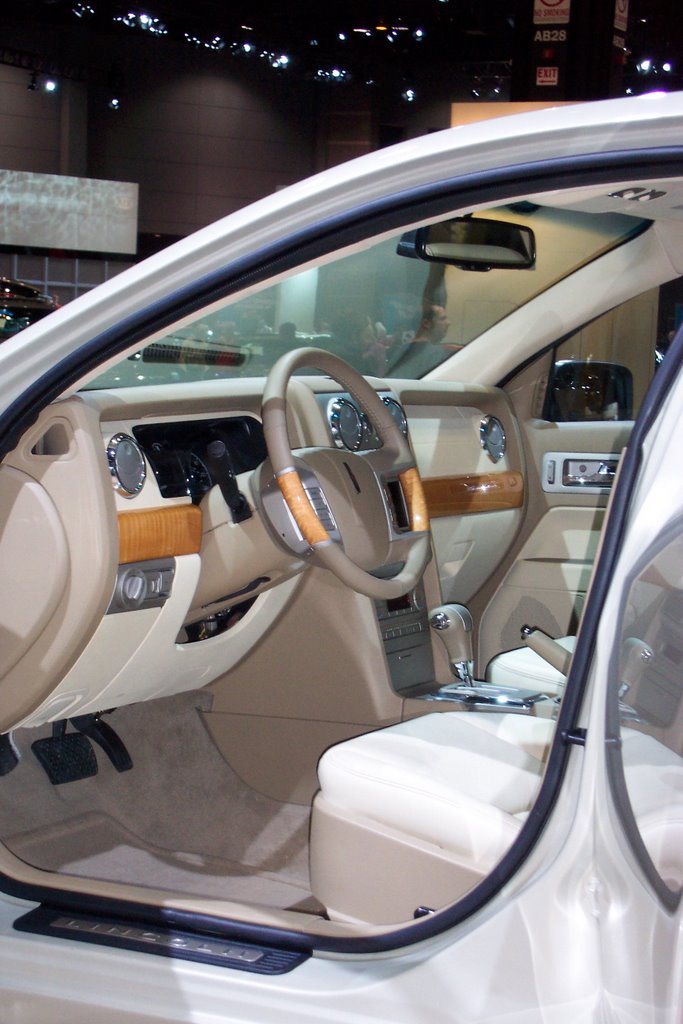
Is there a future for wood trim in auto interiors? According to Monica Link, special correspondent for Automotive News, there definitely is a future and baby boomers are driving the trend because they can afford to buy the luxury cars and trucks that usually feature the look in their interiors.

Ironically, and for no apparent reason, boomers who were born between 1946 through 1964 prefer wood in interiors with dark tones and the younger generation born after 1977 like lighter interiors, whether wood or other material. According to figures provided by J. D. Power and Associates, both groups are now purchasing more than 49 percent of luxury and mid-sized vehicles sales in recent months.

According to Ms. Lisa Tucci, color and design manager at interior supplier Lear Corporation of Southfield, Mich., "the younger generation does not have to see real wood." Meaning that interior trim can be highlighted with either wood trim or metallic finishes like brushed or polished aluminum. However, she goes on to say that "the baby boomers want real wood."

While many cars feature the look of wood - like my 2001 Dodge Neon with the leather interior option - it is not the real thing. Rather, it is probably a photograph or a film of real wood glued to a piece of metal. On my Neon, the fake wood looks absolutely natural and I resisted the urge early on to remove the panels and install instead painted or brushed metal replacements. I'm sure that many people reading this column have owned cars in the past that featured so-called wood interior pieces where the quality was so poor that even a woodpecker with vision problems could tell the difference.

Most luxury makers, however, do use real wood and carefully follow the market to be sure that the tone of wood offered is what clients want. When in doubt, like Infiniti a couple years back, some makers are hedging their bet and are offering wood trim in two tones, light (burled maple) and dark (walnut).

Sherry Sabbagh, a designer for automotive interiors supplier Johnson Controls Inc. in Plymouth, Mich., was quoted in the Auto News article saying that" interior colors often determine what types of woods are used." She goes on to say "Bleached wood in mango and banana colors are very popular. There is no longer just the traditional medium brown."

Burled woods are very popular in cars right now. Automotive wood supplier Behr Industries Corp. of Grand Rapids, Mich., makes 70 percent of its product from burled woods that are harvested in California and Europe. Lincoln, BMW and Mercedes-Benz are big customers of Behr.

What is the next new wood for use in auto interiors? Would you believe bamboo. It is an attractive alternative to the popular walnut and maple because of its light finish and the fact that the wood grows as much as 3 feet a day - which keeps supply up and prices down.