Showing posts with label Chrysler. Show all posts

Friday, May 03, 2013

Detroit automakers doing well....sort of

 
The other day in the USA TODAY, a headline in the Money Section caught my eye and made me smile.  It’s been a long time since I’ve seen a headline in the newspaper proclaiming, “Detroit leads March auto sales.” 

As a dyed-in-the-wool domestic automaker defender – some say apologist – it gives me enormous pleasure to read the monthly sales figures out of Detroit and see that the Domestic Three (GM, Ford and Chrysler Group) are slowly but surely gaining sales and even respect.

I am a realist, however.   The improving Domestic Three automakers will never be a dominant force and become known as the BIG Three again.   Presently the best market share that GM, Ford and Chrysler Group could muster in March was 16.9 percent, 16.2 percent and 11.8 percent of U.S. sales respectively.

Back during my college days in the early 1960s, the leading auto news story was rather the U.S. Justice Department’s antitrust division would pursue its goal of breaking up GM because of the giant company’s overwhelming, monopolistic 60 percent vehicle share in the early 60s.  Apparently the government felt that dividing GM into two companies – one made up of Chevrolet and the other selling Pontiac, Olds, Buick and Cadillac – would give competitors Ford and Chrysler Corporation a more level playing field.

Well, as we know, the playing field got leveled all right, and it wasn’t the outcome of an antitrust suit but rather unexpected competition from imports; first from Europe, then from Asia later in the century.

It’s seems almost unimaginable when reflecting on it today that GM once briefly held over 60 percent of the U.S. market, followed by Ford’s typical 25 – 30 percent share and Chrysler’s 10 – 15 percent take.  I recall as a young man how easy it was to remember the size of each American automaker’s market share.  Take GM’s typical 50 percent figure, divide it by 2 to get Ford’s figure and divide again by 2 for Chrysler’s.

My, how times have changed.   Back in the day when the Big Three dominated, the U.S. auto-making triplets garnered almost 100 percent of the market.   Now, as sales figure from last month show, their total U.S. share amounts to a measly 44.7 percent.  My 50-25-12 sales formula of old doesn’t work any more – by a long shot.

Also showing just how different things are, Chrysler is now only a few percentage points behind Ford in market share and the Blue Oval brand is only a tick or two behind perennial sales leader GM. 

Not only did Chrysler survive the severe recession and emerge as a partner with Italy's Fiat, the company managed to revive its dated automotive lineup with a slew of freshly restyled and very successful products. None represented their efforts better than the mid-size 200, a revamp of the unloved Sebring, which was successfully introduced by rapper Eminem at the 2011 Super Bowl. 


From the sales figures, one could assume that Detroit is in one heap of trouble.  But sales share don’t tell the whole story.   A better barometer of company’s health is how profitable it is.   I’m please to report that the Domestic Three are now lean and mean money machines and the future looks pretty good indeed.

Following the hurtful economic implosion of 2008 – with GM and Chrysler emerging from bankruptcy – all of the automakers used the business meltdown to close under-used factories, shed a large number of workers and eliminate hundreds of millions of legacy costs that had been weighing them down for decades.

While the domestic automakers are only a shadow of their formal selves, they are financially healthy and record or near profits are the norm again.  Gone are costly incentives and over-production.  Now the companies wisely sell only what they build.   Too, after working hard to catch up, the quality of U.S.-made vehicles is equal to or maybe even better than those built by the foreign automakers.

The aforementioned USA TODAY article pointed out that the “Detroit automakers ruled the March sales charts, parlaying their truck and SUV expertise into solid gains while Asian rivals – except for Honda – lagged.”  I swelled with pride when I read that lead off statement.

USA TODAY’s auto writer ended his column by noting the following auto trends and I paraphrase.
- The strong uptick in pickup sales will benefit the U.S. automakers because they still dominate the full-size pickup market.   With the improving housing market resulting in more houses being built, homebuilders will be replacing pickups and that spells good news for Detroit.  It has been reported that automakers can earn up to $10,000 to $15,000 net profit on each truck sold!
- SUVs are still popular and those expensive models are cash cows for the Domestic Three as well.  GM recently freshened its three middle priced SUVs, the Chevy Traverse, GMC Acadia and Buick Enclave.  All three experienced robust sales increases in March.  Happily, GM will be replacing its full-size and popular Suburban, Tahoe and Yukon models later in the 2014 model year.  Ford’s Explorer had its best March since the current model was introduced in 2010.  Chrysler’s Dodge Durango/Jeep Grand Cherokee were also recently freshened and are gaining many new buyers.
- While Toyota, Nissan, Hyundai and Kia all experience either flat sales or declines, Honda managed a 9.4 percent increase in sales in March, thanks to brisk sales of its all-new Accord and CR-X and the freshened Civic.

So it is a good time to be a Detroit Three adherent.  The domestic automakers have not only dodged another economic bullet, but have emerged in pretty fine shape to face another day.  I couldn’t be happier.


Sports car enthusiasts are grateful that GM's bankruptcy troubles in 2009 didn't postpone too long the introduction of the 7th generation Chevy Corvette Stingray.  A huge crowd pleaser at every auto show, the Bow Tie division appears to have hit a home run and will offer a true world beater in the competitive sports car market, starting later this summer.


Ford weathered the Great Recession and now offers a line-up of winners including the Focus, Fusion and Explorer.  Needing a lot of work is the Blue Oval's luxury brand, the Lincoln.   Arriving now at dealerships - be it belatedly - is the all-new MKZ luxury sedan (shown).  Next up is the smartly styled MKX crossover based on the popular Ford Escape, introduced as a concept at the January Detroit auto show.  


Friday, February 08, 2013

Dar's and Chuck's top ten beautiful and homely cars

 
I’m writing this column in the south, enjoying 70-degree temps and observing from afar the frigid and snowy weather that engulfed the Midwest just after I departed St. Joseph.

Joining me is my good friend Chuck Hassel, a fellow car nut who grew up in the Chicago area but now resides in South Carolina.  We’ve make our visit south each January to escape the colder northern climes (well, at least I do) and, more importantly, to discuss cars.   We love all kinds of cars, be they new or old.

Chuck has been ogling cars since he was a little kid.   His education includes degrees in engineering from Purdue and product design from Art Center College in California.

I showed Chuck a copy of my last week’s column about the Hemmings Classic Car editorial with Richard Lenitello’s eight ugliest cars and my reaction to his selections.   Naturally we began coming up with ugly candidates of our own.   We agreed up with our top ten list.

We also thought it would be fun to see if we could come up with a list of the ten most beautiful cars.   It was a challenge, but we did it. 

So, behold, our list of the ten homeliest (ugly seems too cruel a word) and ten most beautiful American cars ever offered.  After each vehicle selected we have added a brief remark on why it was selected:

TEN HOMELIEST VEHICLES:
            1937 - ‘39 Willys (bug-eyed headlights and a pointed snout)
1958 Buick (massive looking, a ponderous chrome-mobile)
1958 Ford (a failed attempt to duplicate the look of the new 4-place T-bird)
            1958 Oldsmobile (see 1958 Buick above)
            1958 Packard (stacked fins and tacked-on quad headlights, a sorry end to a great marque)
            1961 DeSoto (unrelated dual grille openings, clunky-looking taillight housing)
            1961 Plymouth (cabbage grater grille with Halloween headlights that scared small children)
            1980 Ford Thunderbird/Mercury Cougar (the stylist must have lost their French curve, a box was their inspiration)
            2000 – ’05 Chevrolet Monte Carlo (a crisp design that obviously sat too long in the hot sun)
            2001 – ’05 Pontiac Aztek (not sure if it’s a van or a car but not Pontiac’s best effort)
High on many automotive lists of homely cars is the overwrought 1958 Buick, shown here in the Limited series.


The rather scary front end styling of the 1961 Plymouth has been said to be so ugly it scared small children.  It certainly wasn't designer Virgil Exner's best efforts.


TEN BEAUTIFUL VEHICLES:
           
            1933 Pierce-Arrow Silver Arrow (one of the first American vehicles to feature breathtaking aerodynamic lines that set it apart)
1936 Cord 810/812 (Gordon Buehrig’s Cord was a styling masterpiece, radical for its time, still eye candy today)
1939 Lincoln Continental Mk 1 (One of Edsel Ford’s best efforts, providing a must-buy luxury car for the Palm Beach set)
1953 Studebaker (Studebaker stunned American car buyers with Raymond Loewy’s European inspired design)
1955 Chevrolet (featured a Ferrari grille, V-8 power and all-new body of classic simplicity)
1960 Dodge Matador/Chrysler New Yorker (perhaps Virgil Exner, Sr.’s highest achievement and his most successful fin effort)
            1961 Lincoln Continental (award winning then, still stunning to look at)
            1966 Buick Riviera (Words like elegant, graceful and sophisticated are used to describe this Dave Holl’s masterpiece)
            1970 ½ Chevrolet Camaro (in production for 11 years, the crisp, clean  Italianate pony car was a huge favorite) 
1971 Plymouth Satellite coupe (a muscular yet elegant car, it’s bold loop bumper was a perfect compliment to the athletic car)


 This photo, taken at the Concours d'Elegance of Southwest Michigan in St. Joseph, shows me standing in front of one of Studebaker's prettiest coupes ever.  The 1953 - 54 Commander coupe was designed with input from internationally known Raymond Loewy.  Most best looking car lists include this design beauty.

Above is the iconic and great looking 1961 Lincoln Continental 4-door convertible.   Considered by many to be the finest looking Lincoln ever introduced.   Wouldn't it be great if Lincoln could return to market a Town Car-like model that has the impact of this landmark luxury model.

If you don’t recall what some of our selections look like and a photo is not shown, use your computer’s search engine and type in the year and car.  Photos galore will appear to remind you just how ugly or beautiful these cars were.


Saturday, December 15, 2012

I visited the AACA Fall Meet in Hershey and spotted these great automobiles.

This pretty Mercedes had a wood IP!

A classy Mercedes

This 1958 Dodge Sierra wagon was for sale and the price was right.

If I'm not mistaken, this is the first time a two-tone paint stripe was ringed by chrome trim.  I've read that Virgil Exner, Sr. was responsible for this colorful option.

An Exner-designed 1961 Chrysler New Yorker convertible. 

I've always loved gold nomenclature on a white painted automobile.  A 1962 Chrysler

Pretty pre-War Cadillac with two-tone paint.

I've always loved pastel pink and white paint jobs, especially on the 1958 Edsel Citation.

Only Cadillac could get away with offering fins like this and find so many buyers.

Most people like the fastback version of the 1967 - 69 Barracuda.  But I like the coupe look too.   The concave rear window was very unusual for a low priced car.

Gorgeous custom interior on 1966 Corvair 4-door Monza


Prettiest fins on the market.  1959 Buick LeSabre

Unusual trim piece on the 1962 Dodge Polara 500

Virgil Exner seemed to love placing headlights in unusual places.

Wish today's cars could be optioned with these colors.

Sunday, November 04, 2012

Big grilles, side sweeps and fender jewelry

The current "hot" automotive design trend used by designers is the sculptural side sweep.  Utilized successfully on the Hyundai Sonata, the design device gives a vehicle the appearance of being longer and in motion.  In addition to sedans, coupes and convertibles, the side sweep is also found on a number of crossovers and a few minivans.

Auto News trade journal writer Lindsay Chappell wrote a column a while back on auto design.  He started his article with this statement:  “When it comes to designing a new car, it’s really, really hard to do anything new.  Disassemble the pieces of the coolest new designs, and the chances are you’ll have the funny feeling that you’ve seen them all before.”  I can add an amen to that!

Oliver Stefan, head of design for the Volkswagen brand, explained to Lindsay that auto designers using the same design elements on different models around the global industry can’t be helped.  Stefan explains, “I have been working on new design ideas before and I will go to a motor show and look around.  And I will see the same idea already showing up in other cars there.   It’s a remarkable thing.”

According to Stefan, designers from around the world read the same car magazines, go to the same movies and they see the same technologies.  He says similar design cues are not the result of corporate espionage but “just…the same ideas floating up in different places.”

Chappell then goes on to list the long list of auto design elements found on a large number of vehicles worldwide.  Let’s start with one that has been with us the longest, the stylized side vent on the front fender.   I don’t recall who started this practice on a family sedan or SUV, but in the old days they were only found on roadsters. 

Today, you find the chrome pieces on everything from the most expensive SUV (the Cadillac Escalade is a good example) to an inexpensive sub-compact like on the little Ford Fiesta.  But the trend is fading and fewer vehicles use the useless design device.

The current “big thing” design element is the use of a noticeable accent line along the side of a vehicle.  It’s hard to find either a car or crossover without one.  It has become so prevalent on the smaller crossovers that this writer has a devil of a time telling them apart, as they all look the same. 

The ubiquitous accent line can be seen on dozens of vehicles with the Hyundai Sonata being the poster child of the marque using it early and with great success.  According to designers, the angled line, starting high at the rear fender and “lunging” forward and downward to the front fender, give the impression of motion.

Another universal adaptation of a design element mentioned by Chappell is locating the radio antennae on the top of the roof back by the rear window.   According to Chappell, Volkswagen had the clever idea of offering this feature on several models several years ago.  Now the design cue is found on nearly all models of vehicles, from stately luxury sedans to minivans.  According to Chappell, the stubby little radio knob on the roof gives vehicles “ the personality of a remote-controlled toy racer.”

I’m sure most readers have noticed the increase use of LED “eye lashes” on the front-ends of a number of vehicles on sale today.   Chappell shows a photo of an Audi as one of the first to using this design element across all of its models.   In effect, the bright line of lights serve as both a clever and distinctive design cue and also effectively serves as a bright daylight running light.   While not all of the American brands have embraced this newest look, it probably will only be a matter of time before the trend is more widespread.  The all-new Cadillac ATS and XTS have the feature, as does the refreshed Chrysler 300 and 200.  Even Ford has joined the parade and offers the LED lights on a number of new models including the Escape.

Car nuts reading this column are probably familiar with the 2002 BMW 7 Series and its controversial “Bangle Butt.”  Devotees of BMW who didn’t like the new look gave the derisive term to the car.  They weren’t happy when BMW head designer Chris Bangle opted to use a larger and higher rear end than previous generations. 

Well, observers may have not liked the new look but BMW buyers did.   That generation of the 7 sold better than any other.  In the ensuing decade a number of luxury automakers have adopted the look as well as others, including GM with the re-skin of the Chevy Malibu.

Other styling trends mentioned by Chappell that seem to have caught all designer’s fancy include the roof spoilers on crossovers that extend over the rear window.  The Civic CR-V and the Chevy Equinox are examples.   Oversized radiators are the rage with many brands.  Probably the biggest advocate of the big grille is Audi on the car side and GMC with its Terrain and Ford with the Super Duty on the truck side.

I’ve complained in a previous column about poor visibility in current vehicles.  It seems that all the automakers have followed the recent trend in putting really thick “C” and “D” pillars on cars and crossovers/SUVs.   This look is cool but I hope it only stays popular for a short time. 

So there are a slew of auto design elements that seem terribly derivative.   Auto News’ Lindsay Chappell asked, “Why is that.”  Clay Dean, former executive director of GM’s global design and Cadillac design director, told Chappell that there are two primary reasons why this has happened between competitors.   Says Dean, “We have crash standards and pedestrian protection guidelines that tell us what we have to do”  “How far can a hood deflect before it hits the engine?  Those issues affect what the front of a car looks like.”

Dean also adds, “If a design shows up at an auto show today and people like it, you’re going to see those same trends on other concept cars within the year.  I’m not sure that’s a good thing.” 

So will we ever see a huge departure in how a vehicle looks in the foreseeable future?  Sadly, it doesn’t look that way.   For cars and trucks to sell well, you have to please the masses.  Taking chances on a bold, new, never-before-used automotive design is a risk few, if any, automakers are willing to take.

Saturday, October 27, 2012

The choice: 1959 Buick vs. 1960 Dodge


I get asked a lot of car questions.  Some via email, some by phone and some by folks on the street.  Yesterday a bride-to-be emailed me to ask if I could help her locate a vintage car to transport her and the groom from the church to the reception hall.  No stretch limo for her, she wants a 1965 Mustang like the one her husband once owned.

Unless I know the owner of a specific requested model, I usually forward the request on to Ned Wollengslegel, president of the local Southwestern Michigan Car Collectors car club, hoping that he can be of assistance.

Another often-asked question is to name my favorite vintage car.  Over the many decades since I became enamored with automotive design, the answer to that question changes by the week, sometimes by the day! 

For the longest time my favorite cars were the 1957 Chrysler Corporation finned cars created under the direction of designer Virgil Exner, Sr.  One week my favorite would be the Desoto, only to be replaced by the Swept-wing Dodge.  And the 1957 Imperial has appeared at the top of the list many times. 

I’m also a huge fan of the dramatically new1959 GM models that were rushed to market in response to the overwhelming success of the 1957 Chrysler Corporation models.  All five GM models were redone that year with the wild bat-wing Chevy at the bottom of the rung and the iconic “spaceship” finned Cadillac at the top.  I like them all but my favorites have always been the Delta-winged Buick and Linear Look Oldsmobile.  Pontiac with its all-new split grille was easy on the eyes too.

The car that ultimately bumped the 1957 Chrysler Corporation offerings from the top of my Mopar list was another Exner effort that came out in 1960 to replace the by-then dated 1957 Chrysler models.  As I wrote a few weeks back in this column, I was never a big fan of the 1960 Plymouth until recent years, but I really loved the 1960 Chrysler and especially the Dodge Polara/Matador offerings from the get-go.

One only has to attend a vintage car auction to discover the fact that American-built cars from the mid-fifties to the early 70s are favorites of collectors.  And why not?  During that brief 15 years some of the most flamboyant and powerful autos ever to grace a dealership showroom were designed, produced and sold.

Not before and not since have the automakers produced a more varied assortment of models that delighted the eyes with stylistic features (fins, retractable hardtops, tri-tone colors, etc.) and affordable performance (GTO, Roadrunner, etc.)  It certainly is my favorite era of automotive design, bar none.

On my recent Great Smoky Mountains family vacation my daughter asked me to name my favorite car.  Brain freeze prevented me from picking a favorite from my top two picks:  the 1959 Buick and the 1960 Dodge Polara/Matador.  To me, they are both automotive perfection.

It is very rare that a new car comes along that is designed so perfectly (to my eyes) that I wouldn’t change a thing.  I saw the Buick months before its introduction in a summer parade in downtown Flint.  GM held a parade to commemorate it’s golden anniversary. 

The 1959 Buick was on a float and my eyes couldn’t believe that this beautiful car with the canted headlights in front and delta-wing fins in back belonged to a Buick. It look nothing like the bulbous and chromey 1958 model.  I was ecstatic when later that fall my uncle who resided across the road bought a 4-door Special.

Designer Virgil Exner, Sr. had his work cut out for him when he had to replace his successful 1957-59 Chrysler Corporation models.  By 1959 his highly recognized finned look had become passe.  What do you do for an encore?

Exner stuck with the fin look one more year and again produced some spectacular vehicles.  I’ve always loved the Chrysler and DeSotos of that year and I’ve grown to appreciate the Plymouth but I’ve always been gaga over the premium large Dodge Matador and Polara.


Dodge also built a full-size Dodge Dart in 1960 but on a slightly shorter wheelbase.  It shared the Polara/Matador front fenders, roofline and doors but received smaller fins out back and had a cheaper looking grille and was built on the Plymouth platform.  By the way, a nice 1960 red Dart convertible will be in this summer’s Concours d’Elegance in Lake Bluff Park.

The Dart is nice but its bigger brothers, the Matador and Polara, are way better.  That’s because Exner attached two beautifully proportioned and integrated fins on the car’s rear quarters.  Then he topped the new look off by putting gorgeous rocket-like taillights at the rear and a rich-looking grille at the front. A perfect looking car.

I simply can’t decide which I like best.  Guess I’ll have to buy both and get rid of my Neon…after winning the lottery.

Saturday, July 22, 2006

Mopar heaven in Carlisle PA

Mopar Heaven found in Carlisle, PA


Dar looks over one of his favorite Mopar cars, the unloved 1962 Plymouth Fury 2-door hardtop. Downsized while other cars grew bigger, the Plymouth Fury and the Dodge Dart models did not set well with the public and sales plunged.


No doubt most people in our area saved last weekend to attend the 45th annual Krasl Art Fair on the Bluff. Naturally, as the Krasl executive director for 25 years until my retirement last January, that is where you found me too. But this year was different. When the artists set up their tents on Friday night and Saturday morning, I was nowhere to be seen. How come? Cause I FINALLY had the chance to do something that I have been pining to do for a long, long time - attend the annual Carlisle All-Chrysler Nationals in Pennsylvania. The Mopar junkie had finally found his Nirvana.

So over three days, 1,255 miles and a fortune in toll road fees I was able to finally get my Mopar fix at the great All-Chrysler show in central Pennsylvania in Carlisle. Was it worth the wait? You bet and I hope I can go again. Only this time I will allow at least two days. The enormous size and scope of the event surprised me.

I have no way of estimating the size of the crowd, but at $9 a head, I sure would have liked to pocket the day's take on Saturday. The Carlisle Nationals (there is one held for GM and Ford too) is held on the Carlisle fairgrounds. It is a very large space and the Nationals event attract enough participants to fill just about every nook and cranny with invited show-only cars, a vehicle swap meet area and what seemed like thousands of vendors selling everything from ancient car parts to brand new reproductions of gas tanks, not to mention whirly-gigs for the garden.

These events are more fun for me when I can walk the day away with a companion. I met up with a good friend from South Carolina who had been an industrial designer and is now retired. Like me, he had grown up in the 50s and we "cut our car teeth" on the 1955 and 56 cars as we entered junior high school.

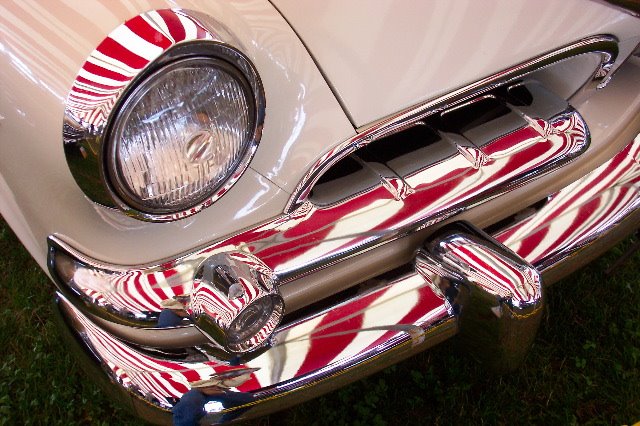
So it wasn't too surprising that the first area we visited at the Carlisle show was the Mopar Survivors Display. I don't know if they feature the survivors display at all the shows, but it is one fabulous idea. Shown under a protective tent (in this case, one with red and white strips that made picture taking almost impossible!), the survivors display has a long line of old cars, from all decades, each in great condition. Most of them are not trailer queens, but rather vehicles that had led a charmed life but are still in use today.

My favorite of the survivors was a 1957 Plymouth Belvedere 4-door sedan that had only 10 or 20 thousand miles on it, with original paint and interior. It looked almost brand new. What really set it off was the coral and while two-tone paint job. Another really nice car on display under the candy cane colored tent was a 1969 Plymouth Barracuda 2-door hardtop ordered with the "mod top" paisley patterned vinyl roof. The mod look was also repeated inside with the flowery fabric repeated on the seat cushions and on the door panels. I didn't notice what engine was under the hood, but I can assure you that it wasn't a huge V-8. No in-his-right-mind muscle car guy would order a sporty car with that option, especially in gold.

Speaking of pony cars. When amongst Mopar fans, you often hear terms like B-body or A-body. At Carlisle this year, it was the E-body that was on everyone's lips. For non-Mopar folks, the E-body is the factory name for the platform used to produce the last generation Barracuda and Challenger.

Maybe the fuss over the long defunct pony cars was because in the past year or so, some E-body cars have sold at auction for over a million dollars. But also adding to the buzz was the fact that on display in an exhibition barn was the 2006 Dodge Challenger concept car. To add fuel to the flames, DaimlerChrysler had only last week announced that the Challenger concept will be put into production in 2008 as a 2009 model. But even if the concept Challenger had not been at Carlisle, the E-body pony cars were THE cars to have on display.

Some readers may recall that when Chrysler finally got their pony cars right with the introduction of the 1970 Cuda and Challenger, the pony car market was at the beginning of a long slide to oblivion. By 1974 the Chrysler twins pony cars and AMC's Javelin were gone and eventually Camaro and Firebird also bit the dust. Only Mustang managed to soldier on and survive. Because the market by 1970 was getting soft, Chrysler didn't sell that many of the models. As a result, it was amazing to see so many E-body cars at this show. I'm a little suspicious. Perhaps someone should count up how many E-bodies have been restored and see if the number exceeds the production count!

The suits in the executive offices at DaimlerChrysler are to be commended for recognizing the significance of an event like the All-Chrysler Nationals and making available the funds to have a very nice display on hand for all to enjoy. Not only did the company have an exhibit on hand, but they also brought a large number of new vehicles along and let visitors get in and slowly drive them around the grounds. The Ride and Drive event was a big hit with the crowds. Besides the expected Durangos, Chargers and minivans, the company reps also had the brand new 2007 Jeep Compass and the 2007 Chrysler Aspen SUV available for driving. Unfortunately, the Dodge Viper wasn't one of the choices.

This column isn't long enough to list all the things that I saw during my daylong visit. A few highlights included seeing on display in the invited cars line-up five (yes five) 1958 Plymouth Furys, all in perfect condition. To have that many rare cars sitting in a row was a visual treat for me.

I'm especially fond of designer Virgil Exner's finned 1957 creations. This show had a boatload of them. It was a delicious treat to slowly walk among these now rare cars and see the many models and makes. Frankly, I am surprised that so many of the poorly-assembled-when-new cars still exist. One of Exner's last efforts at Chrysler before his unfortunate dismissal was the downsized 1962 Plymouth and Dodge. My friend and I love the Plymouth Fury and Dodge Polara/Dart but the general public stayed away from showrooms that year in droves and sales faltered badly. At Carlisle there were several really nice '62 models and it was a special treat to have the chance to see them again up close.

Do you like 1971 Chargers? If you do, you missed the exhibit of a lifetime. Tim Welborn of Alexander City, Alabama brought to Carlisle 12 of his 23 Chargers in his collection. These are not just any Chargers, but perfectly restored specimens and each one has a different engine and drive train (some with the Hemi engine, some with the Six Packs, all in a different color offered that year by Dodge). A splendid sight to behold.

If all this information about Carlisle tempts you to attend next year, be sure to make your motel reservations soon. Rooms are hard to find for miles around the fairground. Want more info on all the Carlisle shows, go to www.carsatcarlisle.com and take a look. Be strong, the temptation to want to go to all the Carlisle events will be powerful, very powerful.

Thursday, July 13, 2006

Carlisle, PA - All-Chrysler Nationals


I took this photo at the All-Chrysler Nationals show at Carlisle, PA on Saturday. I then hurried back to St. Joseph, MI in time to catch a few minutes of the Krasl Art Fair. If I had missed the art fair, it would have been the first time in 25 years! The candy stripe patterns were caused from reflections from an overhead tent. I
thought the effects were rather dramatic.